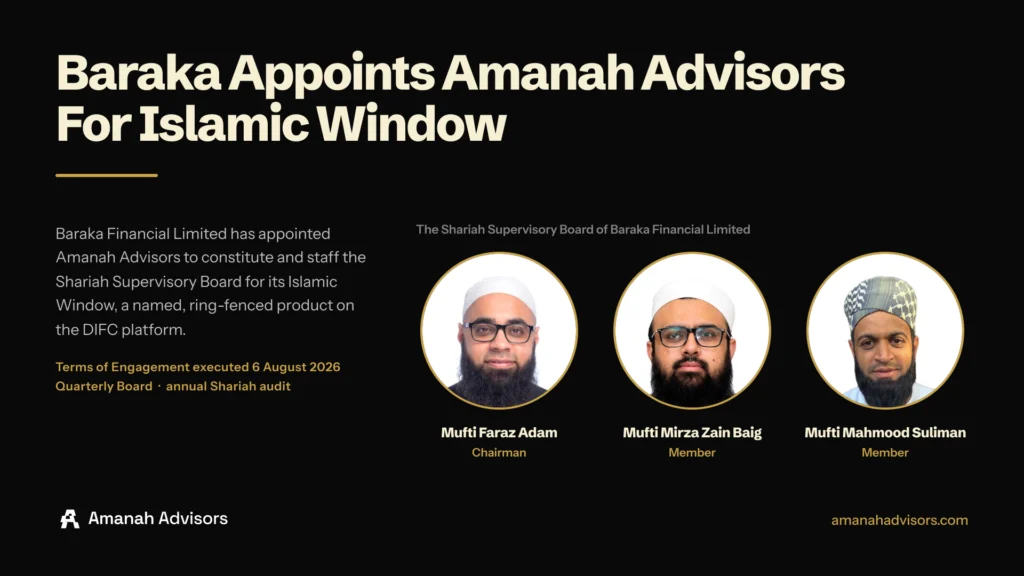
Amanah Advisors has certified the Islamic Window operated by Baraka Financial Limited as Shariah-compliant, establishing a governed investment environment that addresses not only which assets Muslim investors can buy, but how those assets are owned, held and managed throughout the investment journey.
For Muslim investors, identifying a Shariah-compliant stock is only one part of the equation.
Questions around ownership, custody, fractional shares, client cash, gold allocation, purification and the actual execution of trades can be equally important in determining whether an investment experience complies with Shariah.
This was the challenge Amanah Advisors sought to address through its work with Baraka Financial Limited, a Dubai International Financial Centre-based investment platform authorised by the Dubai Financial Services Authority.
Following a detailed review of Baraka’s documentation, systems and operating model, Amanah Advisors’ Shariah Supervisory Board certified Baraka’s Islamic Window as Shariah-compliant.
From Shariah Screening to Shariah Governance
Baraka provides retail investors across the Gulf with access to US and UAE-listed securities and physical gold.
Like many investment platforms, its wider offering also includes financial products that may not comply with Islamic principles.
The objective, therefore, was not to declare the entire platform Shariah-compliant.
Instead, Baraka developed a distinct Islamic Window: a clearly defined investment environment with its own permitted asset universe, exclusions, client-money arrangements and Shariah governance requirements.
This distinction is important.
A Shariah stock screener can determine whether a company satisfies particular financial and business activity thresholds. But screening alone does not answer some of the most important questions arising when an investor actually buys and holds an asset.
Who legally and beneficially owns the shares?
Does ownership and market risk transfer to the investor when the transaction is executed?
Does a fractional investor own a genuine undivided interest in the underlying security, or merely have a contractual claim against the broker?
Where is uninvested client cash held?
Is interest generated on that cash?
When gold is purchased, is specific physical gold actually allocated to the investor?
And what happens when a stock that previously passed a Shariah screen subsequently becomes non-compliant?
The work undertaken by Amanah Advisors was designed to move beyond the simple question of “Is this stock halal?”towards the more complete question:
“Is the entire investment process operating in accordance with Shariah?”
Amanah Advisors’ Work
Amanah Advisors constituted a three-member Shariah Supervisory Board chaired by Mufti Faraz Adam, alongside Mufti Mirza Zain Baig and Mufti Mahmood Suliman.
The firm also developed the Shariah Policy underpinning the Islamic Window and conducted a detailed review of the arrangements governing how investors use the product.
The review included Baraka’s client agreement, client-money and safeguarding policy, best-execution arrangements, operational partnerships, fee structures, anti-money-laundering documentation, investor-facing compliance materials and the methodology and thresholds used by its Shariah screening provider.
Particular attention was given to areas where the practical mechanics of modern investment platforms intersect with classical Shariah requirements.
This included assessing:
- when ownership and investment risk pass to the investor;
- how possession is established where securities settlement occurs after trade execution;
- the legal and beneficial ownership of fractional shares;
- the treatment and segregation of Islamic Window client money;
- the treatment of any interest arising on client cash;
- currency-conversion mechanics;
- the purification of non-permissible income associated with otherwise compliant equities; and
- whether physical gold is specifically allocated at the time of purchase in accordance with the requirements applicable to the exchange of gold.
The assessment was benchmarked against relevant AAOIFI Shariah Standards, including those governing shares, trading and gold.
What Has Been Certified?
The certification is deliberately specific as Baraka offer Shariah non-compliant assets too. Amanah Advisors have only worked on the Islamic Window.
The certfication only covers the Islamic Window operated by Baraka Financial Limited, rather than Baraka Financial Limited as a whole.
Within the Window, the certification covers three principal areas:
1. The Shariah screening methodology
The methodology used to determine which securities may be made available through the Islamic Window and the way those screening outcomes are implemented operationally.
2. The permitted investment universe
This currently includes screened ordinary equities listed in the United States, the Abu Dhabi Securities Exchange and the Dubai Financial Market, together with qualifying fractional interests in those securities, and Islamic Window client money.
3. The Shariah governance framework
The policies, controls, supervision and ongoing audit arrangements designed to ensure that the Window continues to operate within its approved parameters.
The certification does not extend to Baraka’s conventional offering or certify the company itself, its overall balance sheet or its wider revenue model.
Products and activities including conventional bonds, options and other derivatives, margin lending, short selling, securities lending, payment for order flow, interest on client cash and digital assets remain outside the scope of the Islamic Window.
ETFs, mutual funds and sukuk are also not currently admitted as a general asset class within the certified universe.
Building Compliance Into the Product
An important feature of the project is that Shariah compliance is intended to operate at the level of the platform’s processes and controls rather than simply through marketing labels.
The certification therefore carries nine conditions governing the ongoing operation of the Islamic Window.
These include maintaining clear operational exclusions for non-permitted instruments, maintaining separately identifiable records of Islamic Window assets and client cash, ensuring appropriate treatment of client-money accounts, applying and disclosing purification requirements, obtaining Shariah Board approval for representations made in its name and submitting the Window to an annual Shariah audit.
The Shariah Supervisory Board will also meet quarterly, supported by an internal Shariah compliance function.
The result is a model in which compliance can be tested, reconciled and audited, rather than simply asserted.
The Impact
The significance of the project extends beyond determining which securities appear on an investment screen.
It demonstrates what happens when Shariah governance is embedded more deeply into the infrastructure of a modern investment platform.
For the Muslim investor, this provides greater clarity around the questions that sit behind every transaction: what they own, when they own it, how it is held, what happens to their cash and what responsibilities arise when the compliance status of an investment changes.
For financial technology companies and investment platforms, it also provides a more demanding benchmark.
Offering a “halal” filter is relatively straightforward.
Building an investment environment in which asset selection, ownership, custody, execution, client money, purification and governance are all considered together requires a much broader approach.
As Mufti Faraz Adam, Founder and CEO of Amanah Advisors, explains:
“Shariah screening is an important part of Islamic investing, but it is not the entirety of Shariah compliance. We also need to understand what the investor actually owns, when ownership and risk transfer, how client money is treated and whether the operational infrastructure reflects the Shariah principles being represented to the customer. The objective with Baraka’s Islamic Window was to move from a screened investment list towards a governed investment product — one where the underlying rules can be implemented operationally, supervised by a Shariah Board and independently tested through audit.”
For Amanah Advisors, the project reflects a wider approach to Shariah advisory: helping financial institutions translate Islamic legal principles into practical product architecture, operational controls and accountable governance.
The firm works across Islamic investment platforms, funds, takaful, tokenised commodities, stablecoins and other emerging financial products throughout the United Kingdom, the GCC and Southeast Asia.
A Certification With Defined Boundaries
The boundaries of the certification are as important as the certification itself.
It applies to one specifically defined product: Baraka’s Islamic Window.
Renewal is not automatic. It is dependent upon ongoing adherence to the approved Shariah framework and successful completion of the required annual Shariah audit.
This approach reflects an important principle in credible Shariah governance: certification should not simply describe a product at a moment in time; it should create an ongoing framework of accountability for how that product operates.